The Captain Tom Phenomenon: How a Man Became a Movement and What We Can Learn About Hope, Fundraising, and Legacy

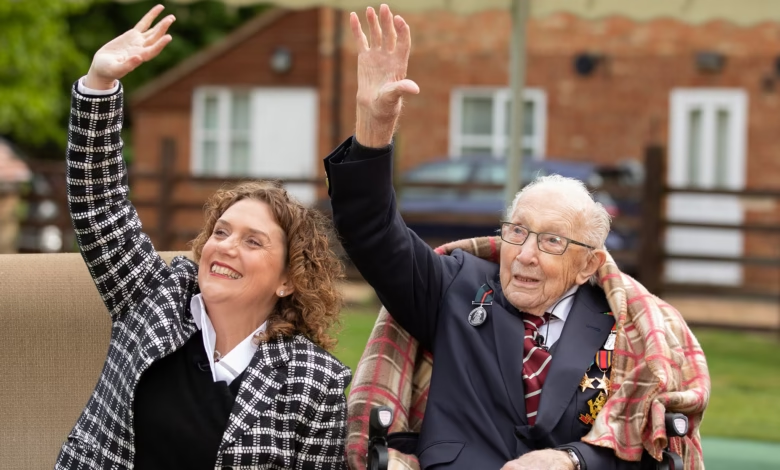
Captain Tom: The Anatomy of an Inspiration
Executive Summary
The story of Captain Tom is far more than a simple tale of charitable giving. It is a profound case study in human resilience, the power of narrative, and the mechanics of modern inspiration. This article delves beyond the headlines to explore the man, the movement he catalyzed, and the enduring framework his actions provide for understanding hope, community mobilization, and legacy building. We will examine the strategic, psychological, and societal elements that transformed a personal challenge into a global phenomenon, offering actionable insights for anyone looking to understand or harness similar positive change.
Introduction
In a moment of collective uncertainty, a single figure emerged from a quiet garden to capture the world’s heart. That figure was Captain Sir Tom Moore, known universally as Captain Tom. What began as a humble, personal goal—to walk 100 laps of his garden before his 100th birthday to thank healthcare workers—exploded into a global narrative of resilience and generosity. The Captain Tom story is not just a feel-good news item; it is a rich tapestry woven from threads of individual determination, strategic communication, and a deep public yearning for unity. This article seeks to unpack that tapestry, moving beyond the surface to understand how an ordinary man executed an extraordinary act that raised an astonishing sum for charity and, more importantly, revived a global sense of shared purpose. We will explore the man behind the medals, the mechanics of the movement, and the timeless lessons his legacy imparts.
The Man Before the Mission: Understanding Tom Moore’s Foundation
To comprehend the magnitude of the Captain Tom phenomenon, one must first understand the foundation upon which it was built. Tom Moore was not a blank slate upon which the public projected its hopes; he was a man shaped by a century of experience. His life prior to 2020 was one of quiet service, marked by his tenure as a captain in the British Army during the Second World War, a career as a managing director in the concrete industry, and a deep, familial devotion.
This lifetime of experience provided the crucial bedrock of authenticity. His military background offered a narrative of discipline and service. His age presented not fragility, but a symbol of enduring strength—a survivor of one global crisis stepping up to confront another. The public did not see a celebrity seeking attention, but a genuine individual acting from a place of personal gratitude and steadfast character. This pre-existing narrative of a life lived with purpose was the essential fuel for the fire that was to come. Without this deep well of authentic personal history, the subsequent fundraising effort might have been viewed as a mere stunt rather than the sincere mission it was perceived to be.
What is the core lesson of Captain Tom’s personal story?
The undeniable power of authentic personal narrative. Captain Tom was not a manufactured persona; his century of life, embodying resilience, service, and quiet dignity, provided the foundational credibility that made his simple action profoundly trustworthy and inspirational to millions. His past gave weight to his present mission.
“The core of Captain Tom’s appeal was his profound authenticity. In an age of curated online personas, here was a man whose character had been forged over a literal century. The public instinctively recognized and trusted that.” — A commentator on public narrative and social movements.
Key Takeaway: The Captain Tom movement was rooted in the authentic, lived experience of the man himself, providing an unshakeable foundation of trust and credibility that no marketing campaign could manufacture.
A Simple Act, Complex Resonance: Deconstructing the Fundraising Strategy
On the surface, the action was straightforward: walk laps of a garden with a frame. Yet, the strategic underpinnings of the Captain Tom fundraising campaign were masterful in their simplicity and alignment with public sentiment. The goal was specific, measurable, and relatable—100 laps by his 100th birthday. It was a challenge that mirrored the shared, incremental challenge the world was facing: taking one step at a time against a daunting obstacle. The beneficiary, the NHS Charities Together, was perfectly chosen, representing the frontline heroes of the moment, which allowed donors to channel their own gratitude and anxiety into a tangible, supportive action.
The strategy leveraged a powerful feedback loop. Initial local media coverage sparked small donations. The compelling visual of a determined elderly man, coupled with the rising donation counter, created a classic “bandwagon effect” supercharged by social media. Platforms like JustGiving provided the frictionless technological infrastructure, while traditional media amplified the story into a daily narrative of hope. This wasn’t a top-down campaign but a grassroots surge that media and platforms efficiently served. The Captain Tom model demonstrates that the most powerful strategies are often those that connect a simple, human-scale action to a vast, collective emotion, using available tools to lower the barrier to participation.
A Real-World Comparative Insight:
Consider a typical charity marathon runner. They also set a physical challenge for a cause. The Captain Tom model succeeded where many individual fundraisers plateau because his challenge was perfectly scaled to his perceived ability (making his effort heroic), his cause was universally urgent, and his story possessed a unique, once-in-a-generation narrative hook—his centenarian status—that broke through media clutter. It was the ultimate alignment of individual narrative, timely cause, and scalable participation.
Key Takeaway: The strategic genius of the Captain Tom campaign lay in its perfect alignment of a simple, symbolic action with a universally resonant cause, facilitated by seamless technology and amplified by a media landscape hungry for positive news.
The Psychology of a Global Response: Why the World Needed Captain Tom
To view the millions in donations as merely a response to a fundraising page is to miss the profound psychological undercurrents. The world, at that specific moment, was experiencing a shared trauma—a mix of fear, isolation, helplessness, and grief. Captain Tom acted as a powerful psychological antidote. He represented agency in the face of helplessness, optimism in the face of despair, and community in the face of isolation. Donating became more than a charitable act; it was a therapeutic one, a way for individuals to reclaim a sense of control and participate in a collective story of hope.
His image—a determined, smiling man in a blazer adorned with medals, steadily progressing—became a universal symbol. It transcended language and culture. He was a grandfather figure, a veteran, an underdog, and a hero all at once. This symbolism allowed people to project their own hopes onto him. Supporting him was a way to support the idea of resilience itself. The narrative fulfilled a deep human need for a “monomyth”—a hero’s journey—in a chaotic time. The public wasn’t just funding the NHS; they were investing in a narrative that made them feel better about the world and their place in it. This emotional transaction is the often-overlooked core of the phenomenon’s scale.
Key Takeaway: The unprecedented global response to Captain Tom was fundamentally a psychological one, as his story provided a vital narrative of hope, agency, and shared purpose to a world grappling with collective anxiety and disempowerment.
Beyond the Headlines: The Lasting Framework for Modern Fundraising
While the specific circumstances were unique, the Captain Tom phenomenon offers a timeless framework for understanding modern inspiration and mobilization, applicable far beyond philanthropy. This framework is built on several pillars: authentic personal narrative, a clear and symbolic action, a cause that taps into the contemporary zeitgeist, and technology that enables viral, frictionless participation. It demonstrates that in the digital age, impact is no longer solely the domain of large institutions but can be catalyzed by a single individual with a compelling story and a clear purpose.
This framework challenges traditional fundraising models that often focus on complex messaging and donor segmentation. Instead, it highlights the power of human-scale storytelling. The lesson for charities, community organizers, and even brands is that connecting on a primal, emotional level—through genuine character and simple, actionable calls to participation—can unlock unprecedented engagement. The Captain Tom case study should be examined not as an unrepeatable fluke, but as a masterclass in the alchemy of narrative, timing, and public sentiment.
Key Takeaway: Captain Tom’s legacy provides an evergreen framework for mobilization, emphasizing that authentic storytelling combined with a simple, participative action for a timely cause can generate outsized impact in our interconnected world.
Navigating the Complexities: Legacy, Commercialization, and Public Sentiment
As with any phenomenon that captures the public heart, the story of Captain Tom evolved into a more complex chapter involving legacy, family, and the inevitable tension between public adoration and private life. Following his passing, the narrative expanded to include the work of the Captain Tom Foundation, established to continue his legacy of supporting causes close to his heart. This transition from a spontaneous movement to a structured charitable entity is a natural yet challenging progression, common to many person-led philanthropies.
This phase introduces critical considerations about sustainable legacy management. Questions arise regarding governance, the alignment of new projects with the original spirit of the movement, and the delicate balance between honoring a memory and maintaining public trust. Furthermore, any commercial ventures associated with the name, such as book deals or licensed products, must navigate the public’s protective sentiment. The audience that championed Captain Tom is deeply invested in the integrity of his story. This underscores a vital lesson: a legacy built on public goodwill requires transparent stewardship. The focus must remain steadfastly on the core mission—turning momentary inspiration into lasting, positive change—to preserve the profound trust that was originally established.
Key Takeaway: Sustaining a public legacy like that of Captain Tom requires meticulous, transparent stewardship that prioritizes the original mission’s integrity to navigate the complexities of institutionalization and maintain public trust.
The Ripple Effect: How Captain Tom Changed the Conversation
The impact of Captain Tom extended far beyond the hospital wards funded by his donations. He shifted cultural and media conversations in subtle but significant ways. He prompted a renewed appreciation for the “Greatest Generation,” fostering intergenerational connection. He sparked countless “challenge” fundraisers, inspiring individuals of all ages to undertake their own sponsored feats, demonstrating the viral template he inadvertently created.
Perhaps most importantly, he re-centered narratives around aging and contribution. Captain Tom became a powerful counterpoint to ageist stereotypes, proving that purpose and the capacity to inspire are ageless. He also highlighted the often-overlooked power of “quiet” leadership—leadership through humble action rather than rhetoric. This ripple effect shows that the true value of such a phenomenon is not just in the funds raised, but in the new stories it allows society to tell itself about resilience, community, and what it means to make a difference at any stage of life.
Key Takeaway: The Captain Tom phenomenon created cultural ripple effects, challenging ageist narratives, popularizing a new model of grassroots fundraising, and reaffirming the power of quiet, action-based leadership.
Actionable Insights: Applying the Principles in Your Own Endeavors
While we may not all raise millions, the core principles demonstrated by Captain Tom are universally applicable for anyone seeking to inspire action, whether in community work, business, or personal projects. The first step is auditing your own authentic narrative. What in your personal or organizational history provides genuine credibility for your mission? Next, define a simple, symbolic action. Can your goal be broken down into a clear, visual challenge that others can understand and root for? Third, align with a resonant “why.” Does your cause connect to a broader emotion or need felt by your community?
Finally, remove friction and enable participation. Make it incredibly easy for people to join your story, whether through sharing, donating, or a simple act of solidarity. Consider exploring our analysis of community-driven campaigns for deeper tactical insights. Remember, the goal is not to replicate Captain Tom, but to understand the architecture of his impact: Authentic Character + Simple Action + Resonant Cause + Accessible Participation. This formula, tailored to your context, can move mountains.
Carol Vorderman: A Life in Numbers, Words, and Public Service
Key Takeaway: The Captain Tom model provides a blueprint for inspiration: ground your mission in authentic narrative, communicate it through simple action, connect it to a resonant cause, and design for easy, broad participation.
A Comparative Analysis: Captain Tom and Other Modern Movements
To fully appreciate the unique contours of the Captain Tom phenomenon, it is instructive to place it alongside other modern movements driven by individuals or simple ideas. The table below provides a structured comparison based on key catalysts and characteristics.
| Movement / Figure | Primary Catalyst | Core Action | Emotional Driver | Scale & Outcome |
|---|---|---|---|---|
| Captain Tom | Personal gratitude & age milestone (100th birthday) | Repetitive, physical challenge (walking laps) | Hope, unity, collective gratitude during crisis | Global, tens of millions raised, knighthood, lasting foundation |
| Ice Bucket Challenge | Community-driven dare (originated with Pete Frates) | Social media video of self-nomination | Fun, camaraderie, peer pressure for a niche cause (ALS) | Global viral phenomenon, hundreds of millions raised, significant research breakthroughs funded |
| Greta Thunberg (School Strike) | Moral urgency & political inaction | Symbolic refusal (school strike) | Anger, intergenerational justice, urgency | Global youth movement, massive policy and corporate discourse shift |
| Local Community Food Drive | Immediate, visible local need | Collective donation of goods | Compassion, neighborly support, direct local impact | Hyper-local, addresses acute community need, strengthens local bonds |
This comparison reveals that while the Ice Bucket Challenge was powered by social fun and peer networks, and Greta’s movement by moral protest, Captain Tom’s engine was a profound, apolitical empathy and a shared desire for a unifying hero. His was less a “challenge” and more an “invitation” to hope.
Key Takeaway: Unlike peer-driven or protest-based movements, Captain Tom’s unique power stemmed from his role as an apolitical, unifying symbol of personal perseverance that invited a world in crisis to participate in a collective act of hope.
Evergreen Lessons in an Age of Cynicism
The story of Captain Tom endures not because it was a momentary feel-good story, but because it offers evergreen lessons in a world often dominated by cynicism and division. It is a permanent reminder that leadership does not require a title, but action. That influence is not a product of wealth or youth, but of character and consistency. That in the midst of complex global problems, a simple, human gesture can sometimes provide the most profound clarity.
His legacy teaches us about the mechanics of hope. Hope is not a passive wish; as demonstrated by Captain Tom, it is an active discipline. It is built step by step, lap by lap, through a steadfast commitment to a positive action, however small it may seem. This lesson is perpetually relevant for individuals facing personal battles, for leaders steering organizations, and for communities seeking cohesion. The narrative arc of Captain Tom—from a personal goal to a global symbol—provides a timeless template for how positive change can germinate and grow.
Key Takeaway: The most enduring lesson from Captain Tom is that authentic action, rooted in gratitude and perseverance, remains the most potent force for generating hope and mobilizing collective goodwill, regardless of the era’s prevailing challenges.
Conclusion
The journey of Captain Tom from a garden in Bedfordshire to a knighthood and a permanent place in the public heart is a multifaceted story of our time. It intertwines the personal and the global, the strategic and the spontaneous, the emotional and the practical. We have seen how his authentic life narrative provided an unshakable foundation, how a simple act was perfectly engineered to resonate, and how it met a deep worldwide psychological need for a story of resilience.
His legacy is dual-faceted: the tangible millions raised for charity and the intangible renewal of spirit he offered. It provides a masterclass in narrative power, a framework for grassroots mobilization, and a timeless reminder of the impact one individual can have. The story of Captain Tom is ultimately a testament to the enduring human capacity for hope, the magnetic power of selfless action, and the extraordinary things that can happen when the world decides to walk alongside someone, step by step, toward a common good. His memory challenges us to consider what our own “laps” might be, and how we too can contribute to a narrative of hope in our own spheres of influence.
Frequently Asked Questions (FAQ)
What was Captain Tom’s original goal?
Captain Tom’s original and personal goal was to complete 100 laps of his garden using his walking frame before his 100th birthday. He aimed to raise a modest amount for NHS Charities Together to thank the staff who had helped him with treatment for cancer and a broken hip. The global explosion of support was an unforeseen and extraordinary outcome of this simple, heartfelt intention.
How much money did Captain Tom ultimately raise?
The final total raised by Captain Tom’s walking challenge was staggering. Through his JustGiving page alone, he raised nearly £33 million for NHS Charities Together. This figure does not include additional funds raised through book sales, a charity single, and other spin-off initiatives inspired by his campaign, which pushed the total philanthropic impact even higher.
Why did Captain Tom’s story resonate so powerfully globally?
Captain Tom’s story resonated because it was the right narrative at the right time. During a period of global fear and isolation, he embodied hope, resilience, and gratitude. His advanced age made his effort symbolically powerful, and his humble, authentic character made him deeply trustworthy. People were not just donating to a cause; they were investing in a story that made them feel united and hopeful.
What is the Captain Tom Foundation?
The Captain Tom Foundation is a charitable grant-making organization established after the initial walking campaign to continue Captain Sir Tom Moore’s legacy. Its mission is to support causes that were close to his heart, combating loneliness, supporting palliative care, and helping people facing bereavement, with the overarching theme of creating a legacy of hope.
What are the key lessons from Captain Tom’s fundraising model?
The key lessons include the unparalleled power of an authentic personal story, the effectiveness of a simple and symbolic physical challenge, the importance of aligning with a cause of immediate public relevance, and the necessity of using frictionless technology to facilitate viral participation. The Captain Tom model proves that emotional resonance and human-scale action can outperform traditional, complex fundraising strategies.
Final Actionable Checklist
- Audit Your Authenticity: Identify the genuine, credible elements of your or your organization’s story.
- Simplify the Action: Distill your goal into a clear, visual, and understandable challenge or step.
- Connect to the Zeitgeist: Align your mission with a broader, timely emotional need or communal value.
- Design for Participation: Remove all unnecessary friction to make supporting or joining your cause as easy as possible.
- Steward Trust Meticulously: If success comes, prioritize transparency and alignment with core values to sustain legacy and goodwill.